
The Body as Institution: Boris Charmatz and choreography as a living thought
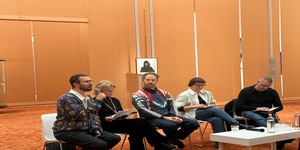

A moment from the conversation with Boris Charmatz
Centro Pecci - Prato
Boris Charmatz, dancer and choreographer, was born in 1973 in Chambéry and trained at the school of the Opéra national de Paris and at the Conservatoire of Lyon. From his earliest works, he stood out for a research practice that combines technical rigour with theoretical reflection, questioning the very nature of dance as language, memory and institution. His work belongs to the legacy of postmodern dance, yet it bears a distinctly conceptual intention: for Charmatz, the body is simultaneously a site of knowledge, a living archive and a critical instrument capable of challenging the codified forms of choreographic knowledge.
This vision takes concrete form during his directorship of the Centre chorégraphique national de Rennes et de Bretagne, between 2009 and 2018, when Charmatz founded the Musée de la danse. The project arose from a radical gesture: transforming a choreographic centre into a museum, yet a museum that rejects the logic of material conservation and inverts the traditional museological paradigm. Whereas the conventional museum preserves objects, the Musée de la danse preserves gestures; whereas the museum immobilises, this new space activates, re-enacts and transmits. Within this framework, the dancer’s body becomes an archive, both the support and the vehicle of the memory of dance. The Musée de la danse is therefore not a building, but a conceptual device: a museum without walls, disseminated through time and space, in which dance itself is exhibited as thought in movement. Charmatz theorises the possibility of a choreographic museum in which knowledge is never fixed but constantly reformulated in the performative act, through exhibitions, lectures, performances and reconstructions that propose a living museography intertwining conservation and invention, archive and creation.
The Musée de la danse marks a crucial theoretical turning point. Charmatz does not intend to musealise dance in the traditional sense, but to use the museum structure as a means to reflect on mechanisms of legitimisation and transmission of artistic knowledge; in this sense, the museum becomes a space for thought, a critical platform that interrogates notions of heritage, documentation and presence, within the tension between memory and oblivion, between the archived gesture and the gesture to be reinvented.
Notable examples from this period include Expo Zéro, an exhibition without objects in which artists and visitors inhabit the museum space through gestures, words and memories; and 20 danseurs pour le XXe siécle, initially conceived within the Musée de la danse, presenting twenty performers engaged in re-enacting extracts from twentieth-century solos. In this work, the history of dance appears as a direct, embodied and mutable experience: not a closed archive, but a collective body in constant transformation.
As a key outcome of this choreographic and performative path, the Manifeste pour un Musée de la danse, written by Boris Charmatz in 2009, stands as a programmatic and theoretical text that radically redefines the notion of a choreographic institution. The manifesto opens with a linguistic gesture of subtraction: Charmatz invites readers to remove from the institution’s name the words centre, choréographique and national. As the modern body itself has lost its centre, contemporary dance no longer requires a symbolic or geographical one, and it is precisely from this void that a new, decentralised and open form of dance can emerge. Similarly, the term choréographique is rejected because dance, in its anthropological dimension, exceeds the choreographic language: it does not belong solely to professionals but to anyone who experiences movement.
Finally, the term national gives way to a global, plural and transnational horizon in which dance becomes a universal language. The closing section of the manifesto, titled Dix commandements, sets out the guiding principles of the project: it is a «micro-musée mais un véritable musée», assuming the responsibilities of a museum while remaining agile and mobile; a «musée d’artistes», conceived and animated by artists rather than curators, where the work is created in the present; a «musée excentrique», which neither classifies nor defines dance, but generates curiosity and a desire for knowledge; a «musée incorporé», built by the bodies of those who inhabit it—artists, spectators, technicians, staff—each contributing to its activation; a «musée provoquant et transgressif», which questions institutional codes, encourages the “pirating” of works and stimulates critical thought; a «musée perméable», open to other languages, traversed by external influences and diverse cultures; a «musée aux temporalités complexes», weaving together the ephemeral and the enduring, the performative and the patrimonial, capable of existing anywhere and at any time; a «musée coopératif», connected to artistic and academic networks, in dialogue with other museums and research centres rather than in opposition to them; and finally, a «musée immédiat», existing from the very first gesture, for its reality is performative rather than architectural.
Charmatz’s Musée de la danse is therefore not a building, but a thought in action, a proposal to redefine both the museological and choreographic institution, replacing the logic of preservation with that of activation, and that of the object with that of the body. In this sense, the museum does not preserve dance: dance itself is the museum.
The manifesto thus anticipates the poetics of Charmatz’s subsequent project, Terrain, launched in the Hauts-de-France region in 2019 after his tenure in Rennes. Here Charmatz transfers the reflection developed in the Musée de la danse from the institutional to the territorial level. Both projects share the aspiration to make dance a site of knowledge, memory and community, conceiving an institution “without walls”: mobile, inclusive, ecological and political. This vision affirms the possibility of an art that, while engaging with the past, continually renews itself through the living experience of the present. If the Musée de la danse embodied a museum without objects, Terrain becomes a company without a theatre, an institution without walls. Its name evokes a return to the materiality of the ground, to the concreteness of place, but also to its open and shared dimension. Terrain was conceived as a platform for creation and research, but also as a political and social experiment through which Charmatz redefines the relationship between dance and public space, between art and citizenship. Its activities are developed through a network of collaborations (with the Opéra de Lille, the Maison de la Culture d’Amiens, and the Phénix in Valenciennes) and take place in unconventional contexts: squares, parks, urban sites and spaces of transit, where the body becomes a medium of encounter, exchange and belonging. The performative dimension opens to participation: projects such as Fous de danse or Terrain Lisboa create collective experiences in which anyone can enter the movement. Dance becomes a shared practice, a civic gesture, a sensory experience that reconnects the body with the territory, where the choreographic act no longer represents but produces relation, inscribing itself in everyday life and amplifying its density.

Boris Charmatz
©Sebastian Dolidon
This passage from the museum to the “terrain” marks a crucial stage in the maturation of Charmatz’s thought. If, in the Musée de la danse, the body safeguarded the memory of dance, in Terrain it becomes an instrument of openness and contamination. The reflection on the gesture as archive is transformed into a reflection on the gesture as ecological and political action; memory gives way to presence, conservation to interaction. The coherence between the two projects is evident: in both, Charmatz interrogates cultural institutions, dismantles their rigidity and reveals their latent potential, aiming to bring forth dance as an embodied and collective form of knowledge, a mode of thought and coexistence. In this sense, Musée de la danse and Terrain represent two phases of a single research trajectory: the first analytical, oriented towards history and memory; the second expansive, turned toward the world and the community. Together they offer one of the clearest redefinitions of the contemporary choreographic institution, demonstrating that dance is not merely an art of movement but a critical tool capable of questioning the structures of knowledge, power and relation. Both experiences rest upon recurring theoretical nuclei: the body as institution, as site of knowledge, memory and transformation; the idea of a living archive, where the history of dance unfolds as embodied practice; the notion of choreographic ecology, which reconnects gesture with environmental and territorial contexts; participation, understood as the dissolution of the hierarchy between spectator and performer; and finally, the search for a new institutional model, based on decentralised forms of transmission grounded in gesture and presence.
Charmatz’s work suggests that for art to remain alive it must continually reinvent its spaces, its instruments and its publics, and that perhaps the true institution of dance is the body itself—fragile, mutable, yet infinitely capable of thinking and acting in the present.
The artistic and theoretical evolution of Boris Charmatz, from the foundation of the Musée de la danse to the Terrain experience, reveals a constant tension towards redefining the boundaries between institution, body and creation. In both projects, dance functions as a critical device that questions the modes of production, transmission and sharing of artistic knowledge. This perspective extends beyond the performative field to the exhibitionary one, where the choreographic gesture becomes a curatorial principle and a space of thought. Within this line of continuity lies the exhibition Le chaos et le brouillon, presented at the Centre Pompidou-Metz in 2025, as a further reflection on the processual and open nature of dance in Charmatz’s vision.

Boris Charmatz
This exhibition offers a poetic and visual synthesis of Charmatz’s choreographic thought, delineating its continuity with the Musée de la danse and Terrain projects. The title, “the chaos and the rough draft”, evokes the idea of creation as perpetual transformation, where dance is defined not as a completed form but as process, experiment and matter in becoming. The exhibition brings together two films made in collaboration with filmmaker Cèsar Vayssié and an autograph text by Charmatz, forming a triptych that interweaves body, image and word. The films Levée (2014) and Danse gâchée dans l'herbe (2023) are both drawn from the same choreographic material, originally developed in Levée des conflits (2010), yet they evolve in opposite and complementary directions. Levée is a collective choreography for twenty-four dancers, filmed in a German mining landscape – an arid, grey terrain swept by wind and dust – where the vastness of the space and the use of aerial shots construct a choral image of dance in which bodies appear as part of a moving topography.
Danse gâchée dans l'herbe, by contrast, is a solo performed by Marion Barbeau and filmed in the woodland surrounding the Pompidou-Metz. It portrays an intimate dialogue between dancer and nature, between light and darkness, where fragility becomes a poetic gesture. The two films form a diptych built on oppositions: collective and solitary, day and night, silence and sound, aridity and vegetation. Both stage a “spoiled” dance – gâchée in the sense of “ruined” or “disturbed” – exposed to non-ideal environmental conditions. Charmatz and Vayssié treat these imperfections as an aesthetic principle: stripped of academic purity, dance becomes a vital, contaminated event, capable of surviving within chaos. The notion of “spoiled dance” thus refers to a poetics of risk, to the possibility that the choreographic gesture may transform itself through the unexpected, the error or the obstacle.
In his writing Le chaos et le brouillon, first published in 2024 in the «Nouvelle Revue Française», Charmatz deepens the theoretical dimension of this poetics: “chaos” and “rough draft” designate the tension between form and disorder, between the desire for control and openness to indeterminacy. Dance, he writes, is “a space where something happens”, not a codified language but a field of experience where improvisation and history, fragility and resistance, coexist. The oxymorons that punctuate the text—“lascivious and stony gesture”, “frenzied and dormant dance”, “collective and solitary”—describe the contradictory essence of movement, always poised between impulse and construction.
From this perspective, Le chaos et le brouillon stands as a meditation on choreography as an intermedial field of experimentation. Between cinema, dance and writing, Charmatz reaffirms his idea of “choreography as terrain”: a shared and mobile space where gestures circulate and are continually reinterpreted. The exhibition also reasserts the central principle of Charmatz’s poetics: dance is not a stable form but a process nourished by contamination. As in the Musée de la danse, the choreographic act is a living archive; as in Terrain, it is a gesture exposed to the world, vulnerable yet open. Here, chaos is not disorder but a generative condition, and the brouillon is not failure but potentiality. In essence, Le chaos et le brouillon is both poetic and theoretical self-portrait: an exploration of dance as a space of thought, a laboratory where body, text and image intersect to challenge the limits of perception, representation and movement.

Boris Charmatz
©Sebastien-Dolidon