
Il viaggio di Eleonora Duse intorno al mondo
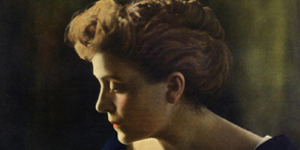
Fundamental core of the project by Maurizio Scaparro Italian theater in the world , conceived on the occasion of the national celebration of the 150th anniversary of the Unification of Italy, is the exhibition dedicated to Eleonora Duse, all from "look, listen and read" to say it the words of < b> Renzo Tian . The exhibition, curated by Maria Ida Biggi and the Scaparro itself, is currently at the Teatro della Pergola, after a first stop at the Vittoriano Complex. There are several points of contact between the great actress, the Pergola and Florence in general. Memorable is the representation of Rosmersholm & nbsp; on December 4, 1906 in the historic Florentine theater, which united the art of Duse with the innovative genius of Edward Gordon Craig .

Portrait of Eleonora Duse in , around 1890 & nbsp;
The exhibition - accompanied by a catalog of contents and iconographic documents - intends to restore the complex personality of Eleanor Duse as a leading woman - artist and intellectual at national level, but also a skilled entrepreneur of herself. The importance of the presence in the theatrical life and of the social environment of united Italy is emphasized. Enrichetta where Duse, referring to the First World War, speaks of a "horrendous but necessary" war, letters of gratitude sent to the soldiers at the front and photos that see her next to them, as well as the innovative enterprise of founding at Library House for Actresses in 1914,
The exhibition aims to shed light above all on the international dimension of the divine actress through documents the main feature of the Giorgio Cini Foundation of Venice, the Civic Museum of Asolo and the Burcardo Library and Theater Museum of Rome. The 15 stages of the Duse's foreign performances , the dominant figure of her artistic biography, are reconstructed in the perimeter of the Sala Oro della Pergola. The tours , started in 1885 with the company of Cesare Rossi they continued unabated until 1909, to be resumed in 1923 in that last tiring pilgrimage to the United States suddenly interrupted in Pittsburgh on April 21, 1924. The destinations were the main squares of Western European theater to reach Russia, Egypt, the United States and South America.

Eleonora Duse, around 1890 (Portrait Michele Gordigiani)
Posters, room programs, painted and photographic portraits, stage photos, caricatures, scenographic sketches, correspondences, chronicles and contemporary reviews, balance sheets, honorary memorabilia, scripts with handwritten notes and handwritten notes allow us to discover the artistic choices of the Duse stage art, able to conquer even the difficult Parisian public so much to the obscure the myth of the eccentric and beloved Sarah Bernhardt . Bearer of national identity around the world, Duse always and everywhere performed in Italian, receiving continuous support. The success of the South American tour of 1885 can be seen in a letter from the Brazilian emperor, Don Pedro II , to the first woman of the Italian theater of the second half of the nineteenth century, the marquise Adelaide Ristori , an ideal artist and entrepreneur for Duse. Impressions of other exceptional spectators such as Chekhov , Chaplin < Victoria of England shed light on the incomparable art that his person emanated on the scenes. & nbsp;

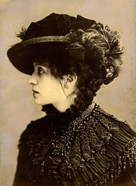
Eleonora Duse in Antonio and Cleopatra , around 1890 (Photo Audouard)

Eleonora Duse in The Lady from the Camellias , around 1895
There is no lack of amulets and personal objects of the actress, from the tea service carried around the world to the glass and silver paperweight with a dedication by Aur & eacute; lien Lugn & eacute; -Po & euml; . Margaret Gauthier, Fedora, Odette, Mirandolina, Santuzza, Cleopatra, Nora, Hedda Gabler and Francesca da Rimini. The room is dominated by majestic portraits that perpetuate the myth of his image and characters. A multimedia station collects documentaries from the Archive of Light and testimonies from family members, biographers and men of the scenes who have known it close, while on a vast graphical globe
A section of the exhibition concerns Eleonora Duse's relationship with cinema. At the back of the Gold Room, (1916) is projected, the actress's only concrete experience in the field of cinema, "the art of silence" as she used to call it. The film, which sees Dusa as the protagonist and co-author with Phoebus Mari in the choice of the subject of the script, is a precious testimony that shows today's audience the gestures and kinetic grace of the "divine" actress.
Il viaggio di Eleonora Duse intorno al mondo
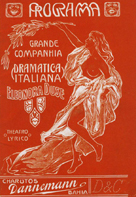
Title page of the Theatro Lyrico program in Rio de Janeiro, 1907
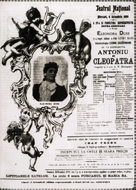
Poster by Antonio and Cleopatra at the National Theater in Bucharest, 1899
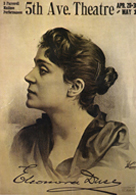
Poster of the 5th Avenue Theater in New York, 1896
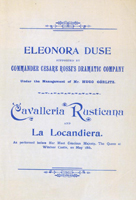
Program Cavalleria Rusticana and The innkeeper
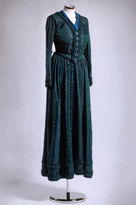
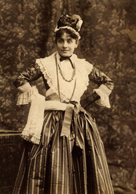
Stage costume for